Rotor wash & formation spacing
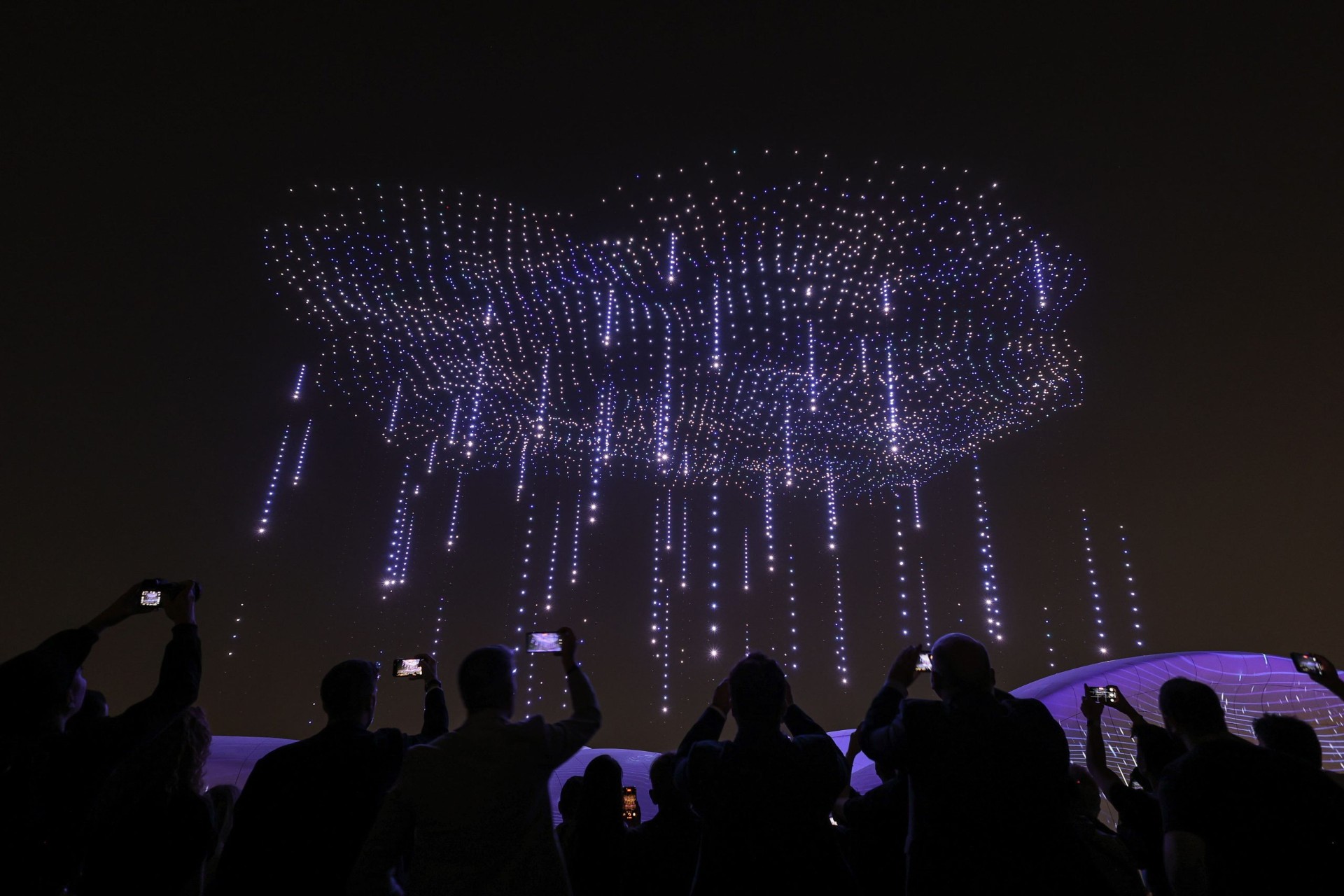
Downwash from a quad-rotor extends ~3× rotor diameter. We compute a per-craft exclusion volume and inflate it dynamically in turbulent wind so swarm density stays below induced-shear thresholds.
Engineering reports on aerodynamics, swarm autonomy, and the operating system that runs the choreography.
Downwash from a quad-rotor extends ~3× rotor diameter. We compute a per-craft exclusion volume and inflate it dynamically in turbulent wind so swarm density stays below induced-shear thresholds.
When gusts cross 12 m/s, Sky-OS rotates the entire formation to keep each craft's nose-into-wind component below 18°, trading a small bearing offset for a 4× reduction in attitude correction.
Each craft reports state-of-charge every 250 ms. The choreography compiler schedules high-energy moves (rapid climbs, fast translations) into the first 60% of the show, then drops into low-current hold-and-glow patterns.

Sky-OS ingests After-Effects timelines, CAD silhouettes, and live MIDI/OSC input, then compiles them into per-craft trajectory bundles with collision-free margins solved over the entire airspace volume.
A custom UDP mesh with adaptive forward-error-correction keeps end-to-end latency under 200 ms across 5,000 craft, surviving 12% packet loss without visible glitches in formation.
Every craft runs a local autopilot that holds station for 30 s on link loss, then executes a deterministic return-to-launch — independent of the swarm controller.
Shows are rehearsed against a digital twin of the airspace — wind, no-fly zones, audience geometry — at 60 fps before a single rotor spins.

Every flat surface in the city has been monetised. The volumetric airspace above the audience is the only canvas still measured in tens of thousands of people per square kilometre.
Read field note →
How we route audience input through the show controller and into 1,500 simultaneous flight paths without breaking choreography.
Read field note →
Designing a multi-act spectacle against one of the most photographed skylines on earth — and the wind tunnel it creates after sunset.
Read field note →
Six pilots, 180,000 surveyed attendees, and what the data says about three-dimensional advertising recall.
Read field note →